SprintScope
SprintScope connects sprint health, risk-aware work management, capacity visibility, editable communication, and completion forecasting in one local full-stack delivery workspace.
SprintScope is a local full-stack MVP in active development. The primary persisted sprint scenario and core product workflows are implemented, while broader scenario coverage, automated workflow testing, deployment configuration, and product refinements remain ongoing.
- Role
- Product design and full-stack engineering
- Scope
- Delivery-risk modeling, product workflows, frontend architecture, backend services, persistence, analytics, and editable sprint communication
- Status
- Local full-stack MVP · Active development
- Core stack
- React · TypeScript · ASP.NET Core · SQL Server
Product interface
Delivery risk, made visible before the sprint slips.
SprintScope combines sprint planning, risk-aware work management, capacity visibility, explainable delivery signals, editable communication, and completion forecasting in one full-stack delivery workspace.
Product overview
Why this product exists.
Sprint planning tools often show what work exists without clearly explaining what threatens delivery. SprintScope explores how sprint progress, blockers, overdue work, workload pressure, capacity, scope growth, and completion forecasting can be connected in one operational product.
The React and TypeScript interface centers the experience around a Sprint Command Center, risk-aware work management, member capacity, persisted analytics, and editable sprint communication. Each signal remains tied to the underlying projects, sprints, work items, assignments, and delivery evidence.
The local full-stack MVP uses an ASP.NET Core Web API, Entity Framework Core, SQL Server, JWT authentication, and a realistically seeded Sprint 24 scenario. Its main workflows are implemented and persisted locally, while additional scenarios, workflow testing, deployment configuration, and product refinements remain in progress.
Problem / motivation
Sprint tools often separate board activity from the delivery evidence behind it. SprintScope keeps progress, blockers, capacity pressure, scope growth, and forecast factors close to the work that produces those signals.
Product experience
Key features.
- 01
Sprint Command Center
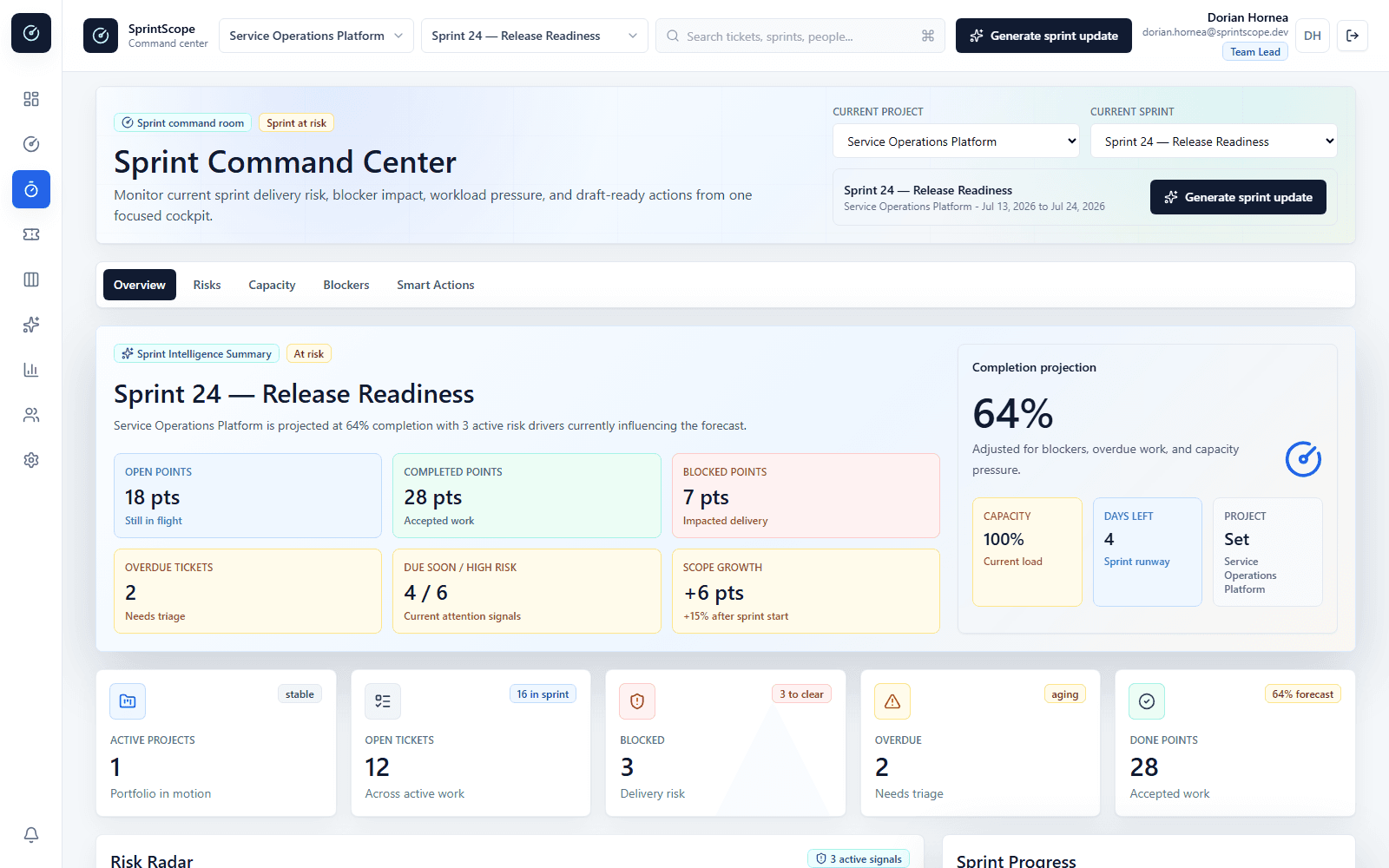
Consolidates persisted progress, blockers, overdue work, scope growth, workload pressure, and completion forecasting in one operational view.
- 02
Explainable delivery-risk analysis
Derives delivery signals for blocked work, overdue tickets, high-risk deadlines, dependency pressure, capacity overload, and sprint scope growth.
- 03
Risk-aware work management
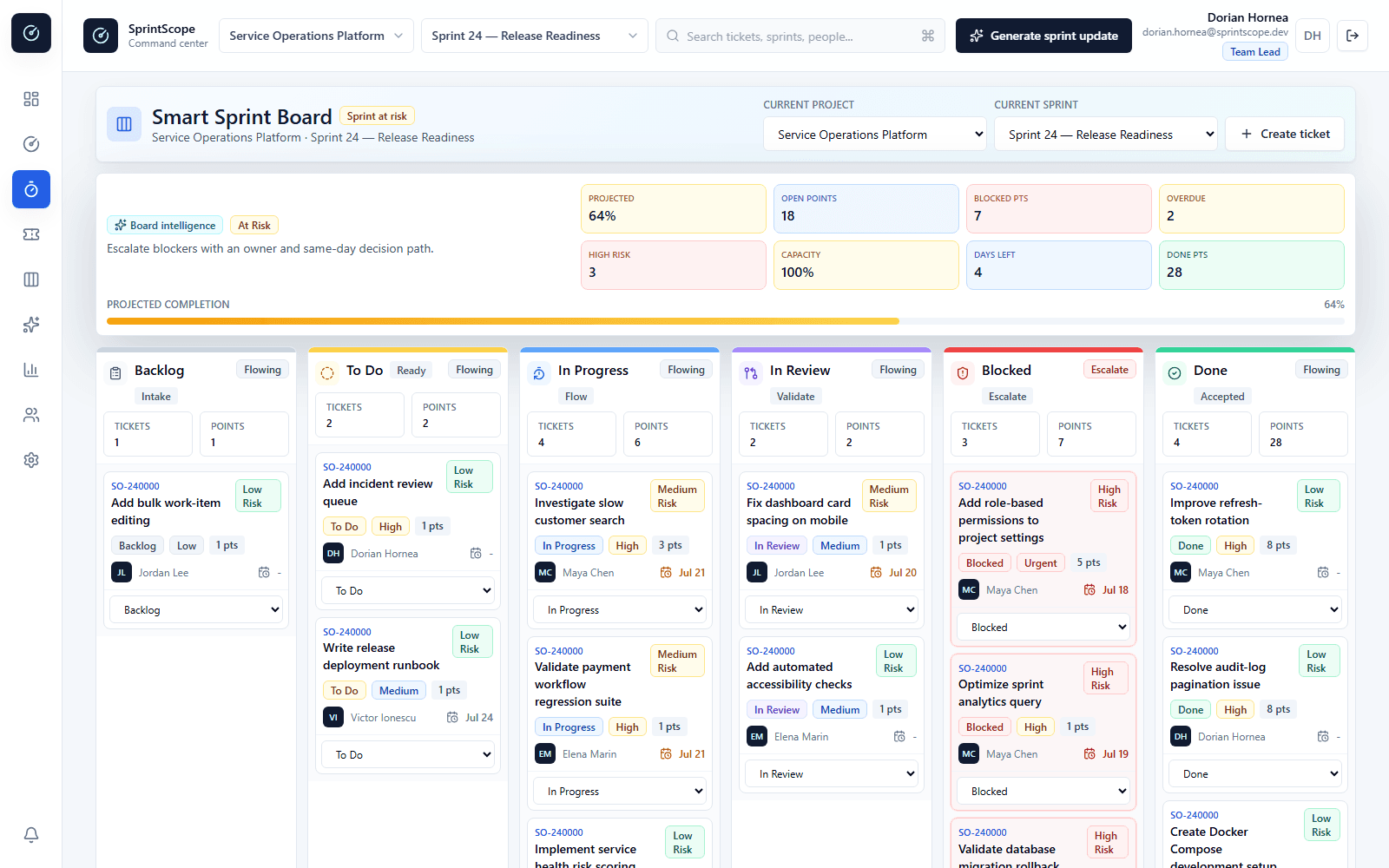
Keeps status, ownership, priority, story points, deadlines, blocked reasons, and delivery signals visible directly on each work item.
- 04
Capacity and workload visibility
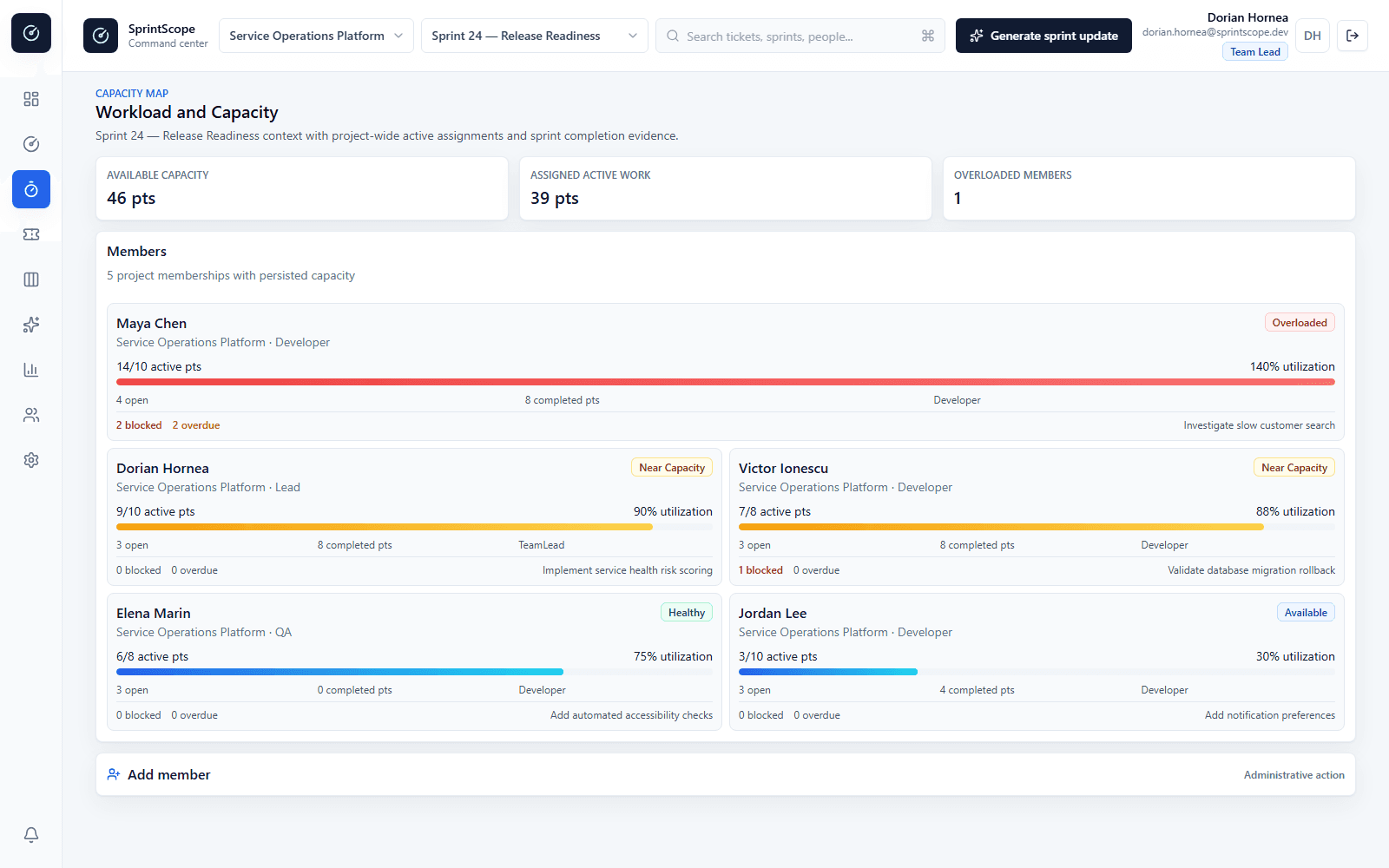
Compares persisted member availability with active sprint assignments and exposes overloaded or near-capacity contributors.
- 05
Evidence-driven Smart Draft
Turns sprint evidence into editable updates, stand-up summaries, blocker escalations, ticket splits, and scope-cut recommendations.
- 06
Persisted analytics and history
Stores sprint state, delivery context, comments, analytics history, and generated drafts in SQL Server so each product view remains grounded in the same scenario.
Under the surface
Architecture and technical challenges.
Architecture
- React and TypeScript frontend built with Vite, Tailwind CSS, shadcn/ui, TanStack Query, and Recharts.
- JWT-protected ASP.NET Core REST API for projects, sprints, work items, comments, capacity, analytics, and Smart Draft workflows.
- Entity Framework Core and SQL Server persistence.
- Projects, sprints, memberships, work items, comments, capacity, risk context, analytics history, and generated drafts share one persisted model.
- Local deterministic services derive risk, capacity pressure, completion forecasts, and editable communication from persisted sprint evidence.
Challenges
- Keeping delivery-risk signals explainable by tying every forecast and recommendation back to persisted sprint state.
- Presenting dense sprint operations data without burying blockers, overloaded contributors, or recovery actions.
- Keeping board, ticket, capacity, analytics, and communication views consistent as the same sprint state changes.
- Producing useful, editable communication drafts while keeping each recommendation traceable to persisted sprint evidence.
- Modeling realistic workflow states without claiming real-team production outcomes.
Technology stack
Delivery status
What exists today.
Implemented
- Sprint Command Center, Smart Sprint Board, ticket context, capacity views, Smart Draft, analytics, and completion forecasting
- Persisted Sprint 24 project, sprint, work-item, membership, comment, and analytics data
- Explainable delivery-risk, workload-pressure, scope-growth, and completion-forecasting logic
- JWT-protected REST workflows and SQL Server persistence
Partial
- The primary Sprint 24 persisted scenario is implemented; broader sprint-health scenarios remain future work
- Workflow-level automated testing needs broader coverage
- Responsive, accessibility, and interaction refinements remain ongoing
- Deployment and operational configuration are not complete
Planned
- Additional persisted sprint scenarios
- Expanded workflow and integration-test coverage
- Production deployment configuration
- Hosted database and secret-management setup
- Further product and interaction refinements
Interface
A closer look.
Surface 01
One view for sprint health
The Command Center turns persisted sprint data into one focused delivery overview. Progress, blocker impact, remaining runway, scope growth, capacity pressure, and forecast factors are presented together so the team can understand the sprint's current condition before opening individual reports.
Surface 02
Risk-aware work management
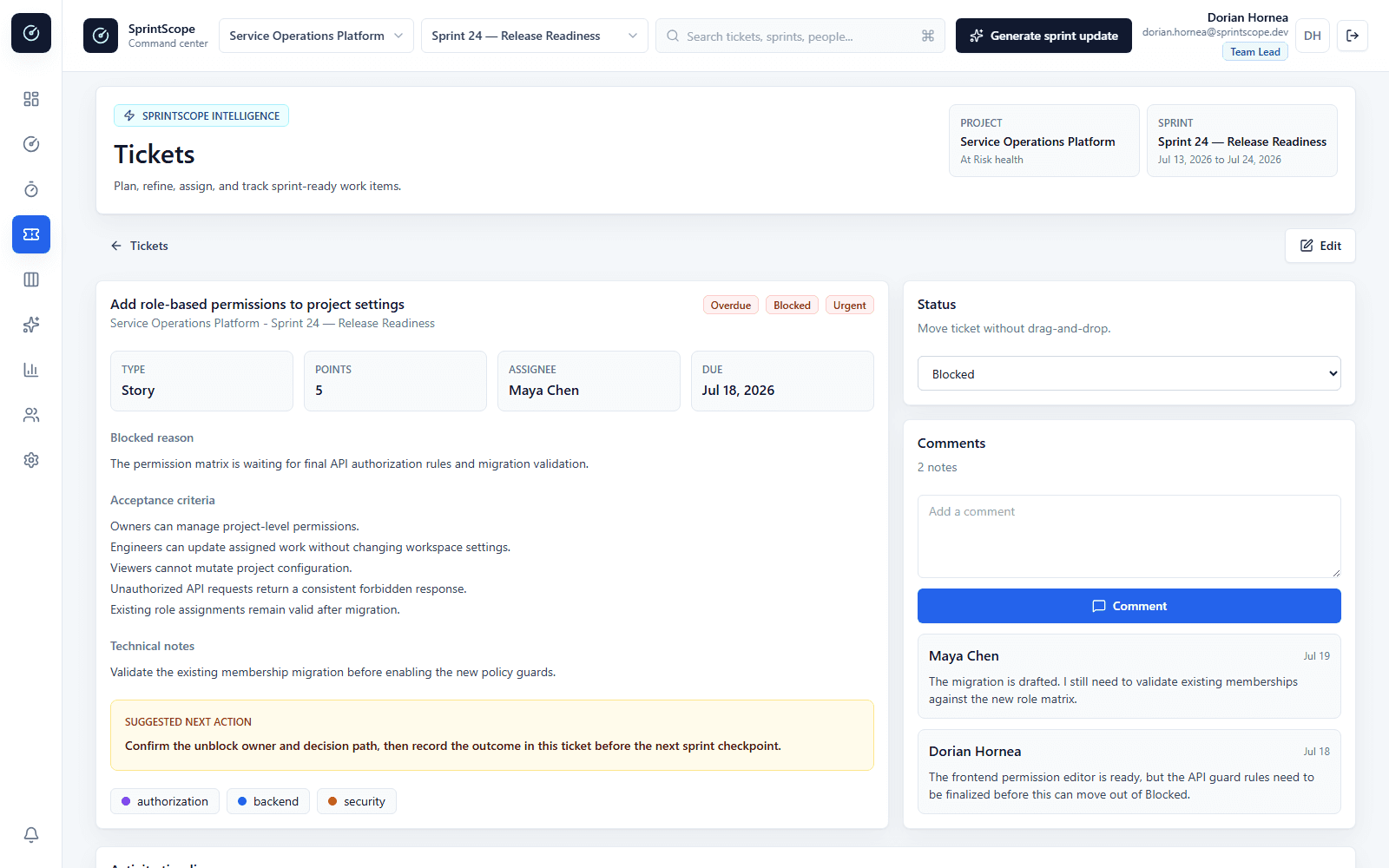
The board surfaces delivery context directly on each work item, while the ticket page preserves the blocked reason, acceptance criteria, technical notes, comments, ownership, deadlines, and suggested next action behind each risk signal.
Smart Sprint Board
Ticket detail
Surface 03
Capacity and delivery outlook
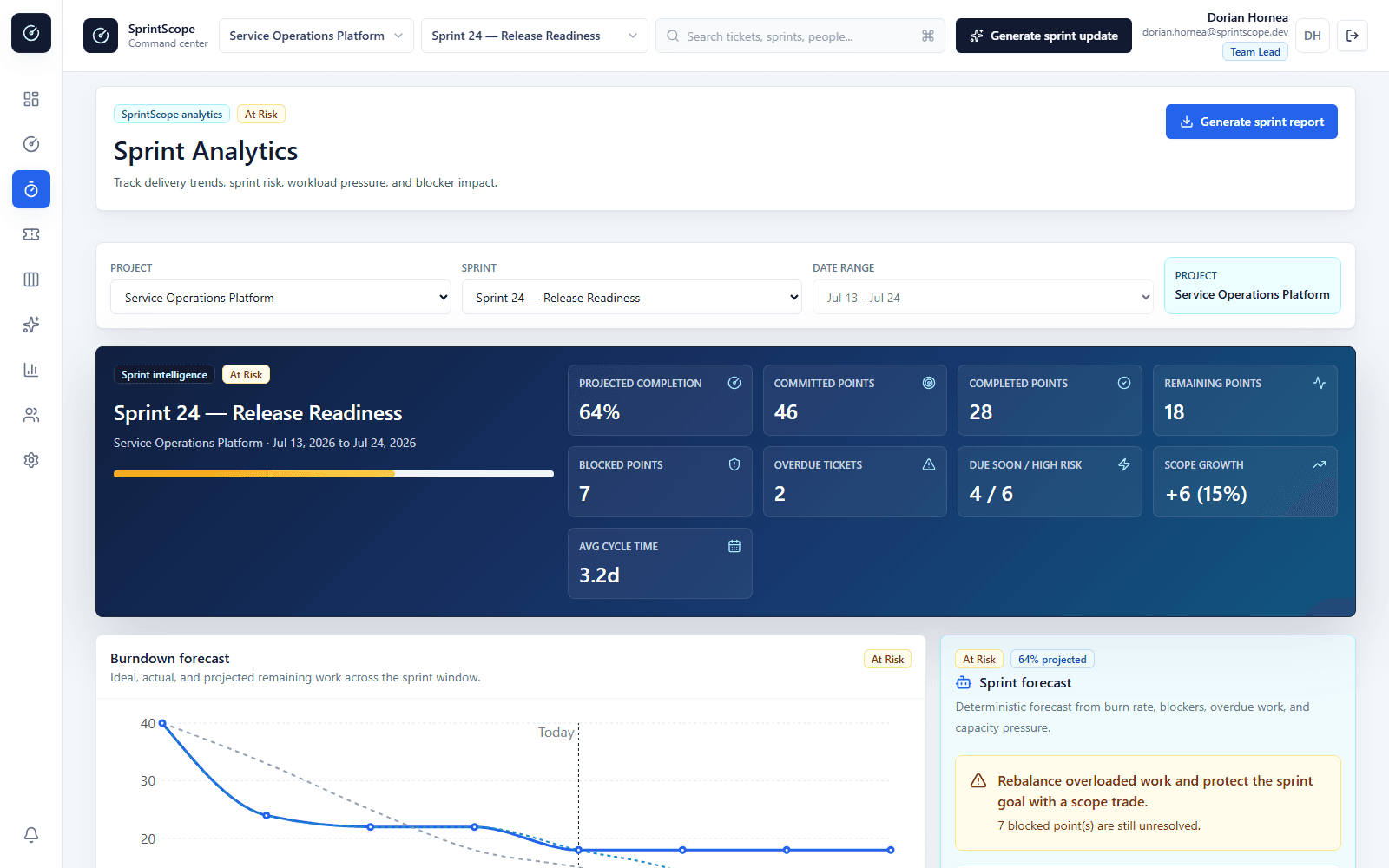
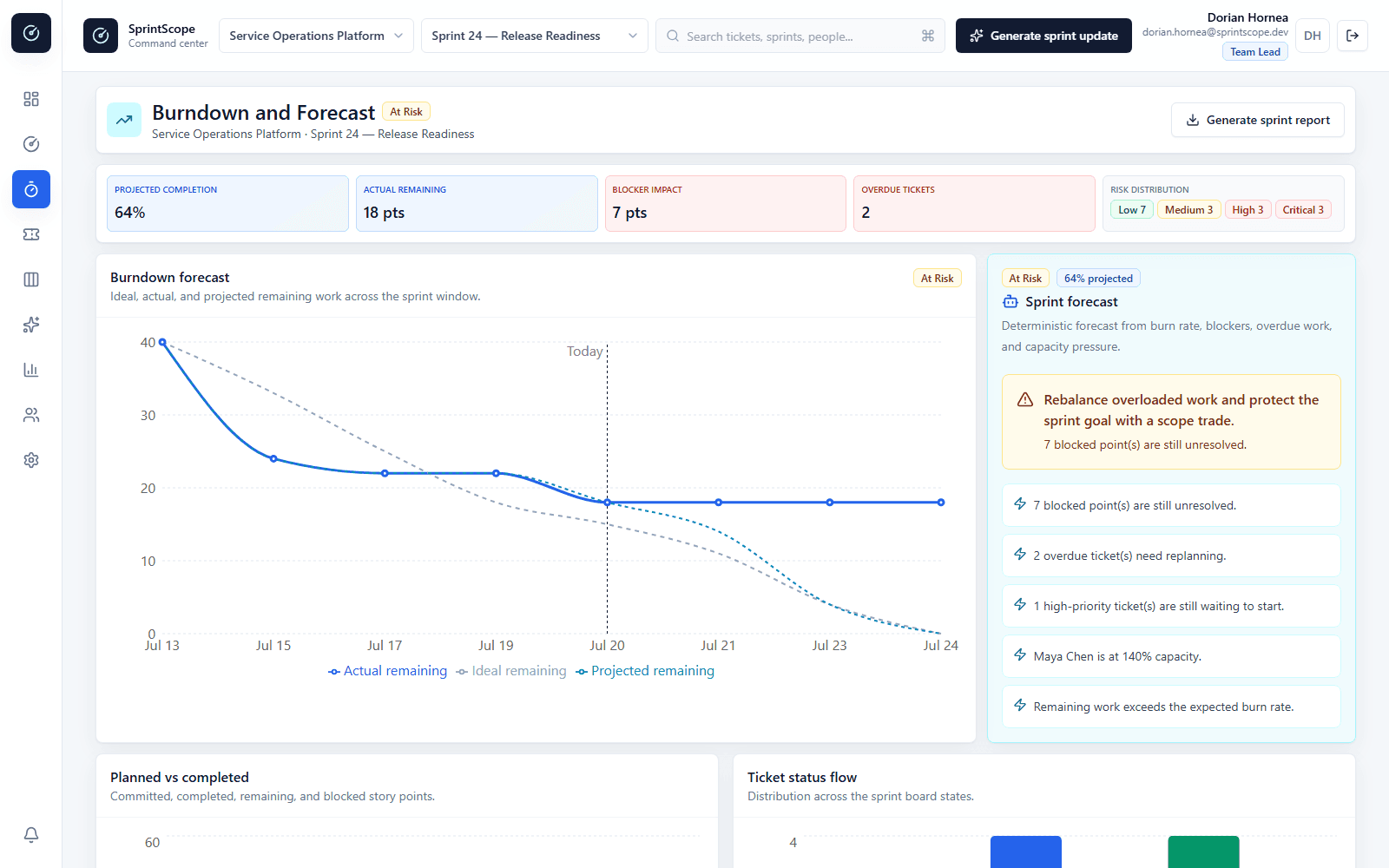
Capacity, analytics, and forecasting use the same persisted project and sprint evidence. The product exposes overloaded contributors, scope pressure, blocked work, sprint history, and the factors behind the projected completion outcome instead of presenting an unexplained score.
Member capacity
Sprint analytics
Burndown forecast
Surface 04
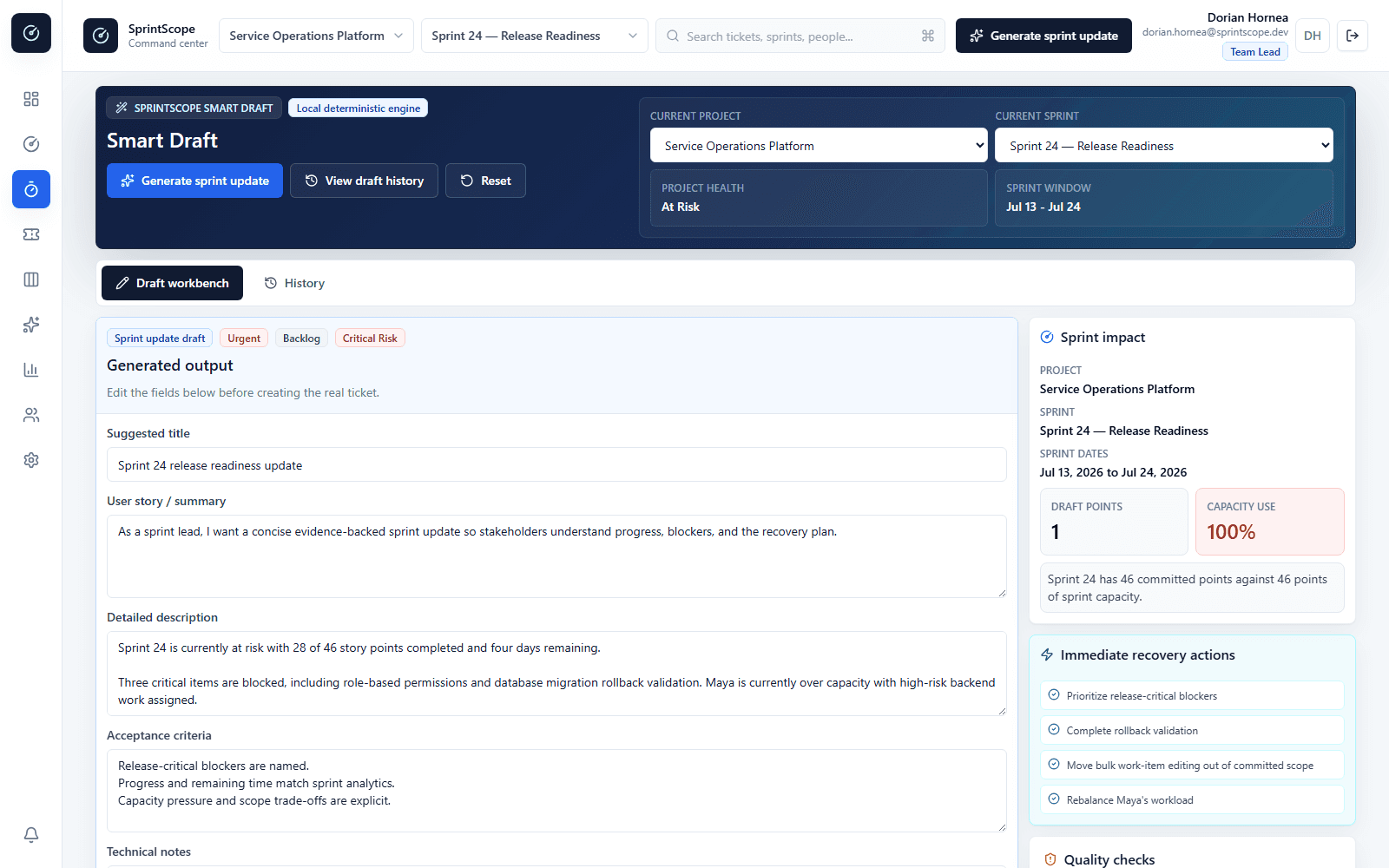
Evidence-driven sprint communication
Smart Draft converts persisted sprint evidence into editable communication and recovery artifacts. Outputs remain reviewable and traceable to the same project, ticket, workload, and delivery signals used throughout the rest of the product.
Honest edges
Limitations and what comes next.
Current scope
- SprintScope is a local full-stack MVP in active development.
- The primary experience is built around one realistically seeded and persisted Sprint 24 scenario.
- The application runs locally with SQL Server and is not currently production-deployed.
- Smart Draft uses a local rule-based engine rather than a paid external generative AI service.
- The project demonstrates product architecture and workflow depth but does not claim real-team adoption or measured delivery outcomes.
- Broader sprint scenarios, workflow tests, responsive behavior, accessibility, and deployment configuration remain under development.
Future improvements
- Expand the persisted scenario set across additional sprint-health states.
- Add broader workflow, integration, and state-transition test coverage.
- Continue accessibility, responsive-layout, and keyboard-interaction improvements.
- Refine forecast explanations and recovery-action workflows.
- Prepare deployment configuration only after hosting, secrets, and database requirements are intentionally defined.